
Allergen Detection Using ELISA
The first step in testing for allergens in a home is to collect representative dust samples from each room to be analyzed using filters attached to the end of a vacuum cleaner hose.
The dust samples are then chemically treated to extract the allergens and dissolve them in a solution.
The various types of allergens present in the extracted solution are specifically quantified using ELISA (Enzyme-Linked Immunosorbent Assay) tests.
This biochemical analysis is based on colorimetric detection of complexes formed through interaction with antibodies. The intensity of the measured color is directly proportional to the quantity of complexes formed and, therefore, to the amount of allergen present.
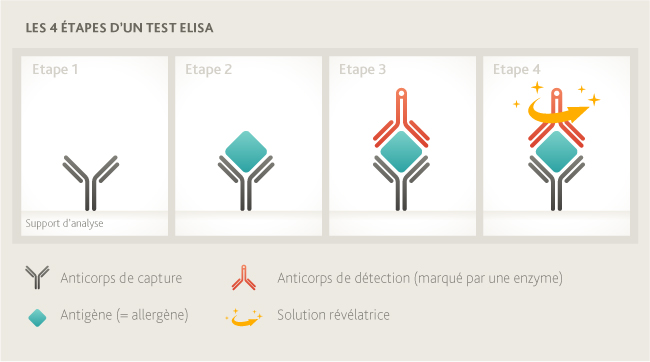
The four steps of an ELISA test
Step 2: After processing the dust samples, the solution containing the allergens is applied to the antibodies. The allergens present bind to the antibodies.
Step 3: Enzyme-linked detection antibodies are applied to the test substrate. They bind to the allergen-antibody complexes formed in the previous step.
Step 4: A developer solution containing an enzyme substrate is applied to the test strip. The appearance of a color indicates the presence of the enzyme and, therefore, of the allergen. The intensity of the color is proportional to the amount of allergen present.
The concentration of allergens in the sample is then determined by measuring the intensity of the color and comparing it to measurements obtained for known allergen concentrations.