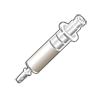
Sampling Media
The Kudzu Science laboratory has selected sampling devices that are particularly easy to use to facilitate the sampling process.
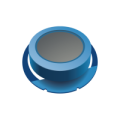
For indoor air sampling, two types of badges specially designed for analyzing chemical pollutants in your indoor air are provided: one for Volatile Organic Compounds (VOCs) and the other for aldehydes (such as formaldehyde). These organic compounds are present everywhere in the air inside our homes.
Place the badges in the room to be tested and leave them there for 7 days without touching them. Then all you have to do is wait!
To collect a dust sample, a universal vacuum cleaner attachment is included with the kit. No need to change the vacuum bag, no need to touch the dust—it’s really that simple.
Volatile Organic Compounds (VOC) Sampling Pad
The sampling badge for measuring VOCs as part of indoor air analysis contains a small amount of activated carbon, which binds VOCs. This badge is safe for children and pets.
After 7 days of sampling and once it arrives at our laboratories, the badge is opened and the activated carbon is recovered. The activated carbon is then placed in contact with a liquid (solvent) that extracts the VOCs bound to the activated carbon. After this process, the liquid contains the VOCs. A small portion of this liquid is injected into the GC-MS system (Gas Chromatography coupled with Mass Spectrometry) for analysis. This allows for the measurement of VOCs.
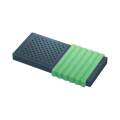
Aldehyde Sampling Patch
The sampling badge for these organic compounds consists of a paper substrate containing a chemical (C) called DNPH (DiNitroPhenylHydrazine). When this chemical comes into contact with an aldehyde (A), it reacts quantitatively (completely) and irreversibly with the aldehyde to form a very stable compound (A-C) bound to the paper substrate. This badge is safe for children and animals.
After 7 days of sampling and once it arrives at our laboratories, the badge is opened. The paper substrate is recovered and placed in contact with a liquid (solvent) that extracts the compounds bound to the paper substrate. After this step, the liquid contains the compounds (A–C), and a small portion of the liquid is injected into the LC-UV system (liquid chromatography coupled with UV spectrophotometric detection). This allows for the quantification of these organic compounds.
Dust Sampling System
The system for collecting a dust sample is very simple and ingenious. It was developed by the American company “Indoor Biotechnologies,” a leader in the field of allergen analysis technologies.
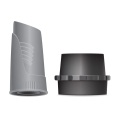
Simply attach a filter and filter holder to the end of your vacuum cleaner hose. Thanks to the included adapter, this device is compatible with virtually all vacuum cleaner models on the market. To collect the dust sample, use your vacuum cleaner as you normally would. The dust is captured in the filter, which you simply send to us.
Hair Sampling System
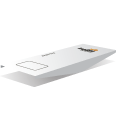
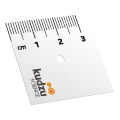
Hair samples are collected using two systems developed by Kudzu Science, depending on hair length: a calibrated cardboard holder or a cardboard scale.
The portion of the hair analyzed is the part closest to the scalp, in order to assess recent exposure.
When the hair is long—that is, more than 3 cm—the sample is collected using the calibrated cardboard holder. Thanks to a circular cutout (3.5 mm in diameter) in its center, this holder is specifically designed to provide a sufficient amount of hair for laboratory analysis. The selected strand of hair is inserted into the circle through a slot specifically designed to facilitate handling. The holder is then pressed against the scalp, and using a pair of pre-washed scissors, the strand can be cut flush with the scalp.
When the hair is short—that is, less than 3 cm long—the sample is collected using a cardboard scale, specially designed to ensure there is a sufficient amount of hair for laboratory analysis. The hair is cut at the root and placed on the designated area of the scale. When the scale tips, the collected amount is sufficient.
To ensure the sample is properly preserved during transport, the hair is placed in aluminum foil, then in a paper envelope, which you can simply send to us using the prepaid envelope provided.
Water Sampling Procedure
Until now, to perform a water analysis, it was necessary to send between 1 and 5 liters of water to the laboratory. To reduce shipping costs and make water analyses accessible to as many people as possible, Kudzu Science has developed an innovative cartridge-based sampling system.
The testing kit contains a plastic bag equipped with a tube for water flow and a filter cartridge. The user fills the bag with 1 liter of the water to be tested and attaches the cartridge to the end of the flow tube. The bag is then hung at a suitable height, and the water flows naturally through the cartridge. Once the water has been filtered, simply return the cartridge to Kudzu Science for analysis.
The contents of the cartridge have been specially formulated by Kudzu Science to bind the pollutants being analyzed (pesticides, PCBs, PBDEs, PAHs, etc.).